The UN Security Council failed to adopt a draft resolution that had been lifted in Iran’s nuclear deal, which had been lifted in Iran’s nuclear deal, which had been lifted in Iran’s nuclear deal in Iran on Friday, September 9. The resolution sought to maintain the lifting of sanctions against Iran, which did not receive […]
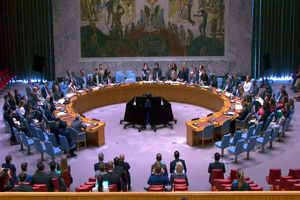
The UN Security Council failed to adopt a draft resolution that had been lifted in Iran’s nuclear deal, which had been lifted in Iran’s nuclear deal, which had been lifted in Iran’s nuclear deal in Iran on Friday, September 9. The resolution sought to maintain the lifting of sanctions against Iran, which did not receive the necessary votes.
China, Russia, Pakistan and Algeria voted solely on the Resolution to continue the lifting of sanctions against Iran, and the two countries, Britain, France, the United States, Sierra Leone, Slovenia, Denmark, Greece, Panama and Somalia voted in a negative vote, and the two countries of South Korea and South Korea.
The trigger mechanism (after the patrol) will not begin immediately by voting for the South Korean’s proposed resolution as chairman of the Council. Rather, this will be a further pressure on the Islamic Republic of Iran to accept the demands of the US and the three European countries within the remaining 6 -day deadline until the end of September.
Opponents and supporters of the return of sanctions against Iran after voting said:
America: Security Council vote paves the way for sanctions
Dorothy Xi, an ambassador to the United Nations after voting at the UN Security Council meeting, said: Iran has enriching uranium much higher than the constraints of the Comprehensive Joint Action Plan (Brjam), in a way that there is no valid civilian goal for it.
The US diplomat justified Washington’s disruption and pressure on the refusal of the continuation of sanctions on Iran in a speech repeating his country’s allegations, saying that on August 7, France, Germany and Britain informed the Security Council that Iran’s nuclear obligations were not significantly implemented. Their discussion was clear. Iran has enriching uranium much higher than the constraints of the Comprehensive Comprehensive Action Plan, in a way that there is no valid civilian goal for it.
Without reference to the US violation, he said: Currently, Iran still does not implement the International Atomic Energy Agency’s supervisory measures and does not temporarily apply the Agency’s Additional Protocol. Three European countries could begin the return process of sanctions early in the year. Instead, they first chose intensive diplomacy with Iran. Then, in July, the three European countries suggested that if Iran take steps to address concerns about uranium reserves rich, it fulfills its commitments to the International Atomic Energy Agency and resume direct diplomacy with the United States, extending the mechanism of sanctions. Despite the rejection of claims from Iran and others, Tehran has not yet understood these conditions.
America: We are happy that the resolution was not approved
“Therefore, the United States voted in favor of the resolution, and we are pleased that the resolution was not approved due to the lack of necessary positive votes,” Xi claimed. The practical impact of the vote is that if the Council fails to fulfill further, UN sanctions will be re -imposed before the year after the end of the six -day return of sanctions on September 9. However, our vote on this resolution will not prevent real diplomacy, despite any other statements.
He said: UN sanctions, which are supposed to be re -imposed, are not arbitrary, but rather to deal with Iran’s conventional nuclear, missile and weapons programs and support for terrorism. Their return does not prevent the subsequent cancellation from diplomacy. Most importantly, US President Donald Trump has continued to confirm the US readiness for a meaningful, direct, and scheduled dialogue with Iran, both before the end of the September 9th process.
The US envoy to the Security Council claimed: In the absence of an agreement, the international community has a duty to accept Iran’s semi -efficient efforts or efforts to postpone accountability: we must press the Iranian leadership in order to choose the path of peace and thus, for the Iranian people.
Britain is a key step in the process of sanctions return today
Barbara Woodward, a permanent British representative to the United Nations, said that today’s resolution is a key step in the process of returning sanctions, which is in the Security Council Resolution.
He claimed that Britain is committed to pursuing a diplomatic solution to ensure that Iran will never seek or develop a nuclear weapon. That is why on August 7, Britain, France and Germany, the council informed the council of Iran’s obvious and deliberate adherence to their commitments.
The British ambassador claimed: Activating the mechanism by the three European countries is a completely legal action, and the Britain and the partners have repeatedly tried to bring Iran back to the negotiating table, but Iran has rejected these efforts every time.
China’s warning: Europe’s action may have exacerbated the confrontation
Fu Kung, a permanent representative of China, at the UN Security Council, who expressed his doubt about the “right of three European countries to use the trigger mechanism” and protested the use of the trigger mechanism against Iran.
For China, he said, in such circumstances, the hasty pressure on voting on draft resolution may exacerbate the confrontation and is not helpful in resolving the problem.
The Chinese ambassador continued: “It was the United States that came out of the agreement, a military attack on Iran and disrupted the talks.” The pressure must be stopped and Iran must approve its program. Its plan has been prepared for collaboration.
The Israeli ambassador to the United Nations welcomed the Security Council’s decision not to lift sanctions against Iran, calling it a “other step towards imposing sanctions on Iran”.
The Chinese ambassador said the country supports the continued lifting of the Security Council sanctions against Iran, and therefore has voted in favor of the draft resolution.
“I have to confirm that we are firmly rejecting some countries’ efforts to implement the trigger mechanism, and we consider such a strongly weakening diplomatic efforts to achieve a political solution to Iran’s nuclear issue,” he said.
“The United States has launched military attacks against Iran’s nuclear facilities, destroying the negotiations itself,” the Chinese ambassador to the United Nations said. It is in this situation that Britain, France and Germany have cited Resolution 2 and insist on activating the trigger mechanism for Iran’s unilateral sanctions. This is unfair and irrational. “
France’s claim: we are a diplomatic solution
The French ambassador and representative to the United Nations also said in a speech: France and other European countries have fulfilled their obligations under Iran’s nuclear agreement. We are committed to working on a diplomatic solution for Iran’s nuclear program.
He added that the International Agency is not capable of determining the fate of Iran’s enriched uranium. Iran should allow the agency inspectors to work in this field. The system of non -proliferation is at risk. Iran has enriched the permissible level of 5 times.
“For France, today’s situation is no longer the same as the conditions that existed in the year 6 when the Security Council measures approved Iran,” he said.
The French ambassador claimed without referring to the US violations of the United States and the European Union: “Since year 2, Iran has decided to expand its activities in relation to the Brigham and take new steps in its nuclear program. “This situation, which has been repeatedly emphasized in the IAEA reports, has created a crisis in connection with the Security Council’s adopted measures in year 6.”
Russia: The return of Security Council resolutions against Iran is “blackmail”
Vasili Nabenzia Ambassador and Permanent Representative of Russia to the United Nations after voting for South Korea’s proposed resolution to continue lifting sanctions against Iran and the defeat of the Security Council due to US and European lobbying and pressure said: “The return of Security Council resolutions against Iran is blackmail and three European countries have no concern about the fate.”
The Russian ambassador from three European countries strongly criticized the process of returning resolutions against the Islamic Republic of Iran, saying that the three European countries had no concern about the fate of the nuclear deal.
Nabenzia condemned the return of sanctions against Iran and said that lifting the sanctions is the only right decision. Surprisingly, South Korea decided to conform to the Western malicious approaches. It is not clear to anyone that the purpose of Britain, France and Germany is to use the Security Council as a lever to put pressure on the government that is trying to defend its interests.
Ambassador and Ambassador to the Security Council also criticized the US and three European countries, saying that there is no military solution to Iran’s nuclear issue and the policy of maximum pressure will be damaged.
Israel’s pleasure to block diplomacy in the Security Council
Israel welcomed the UN Security Council vote and the refusal resolution to continue the lifting of sanctions against Iran and claimed not to allow Iran’s nuclear threat.
The Israeli ambassador to the United Nations welcomed the Security Council’s decision to lift sanctions against Iran, calling it a “other step towards imposing sanctions on Iran”.
“It is good that the world is awake and has joined the fight against violence and terrorism against the Western world,” Danny Danon claimed: “The Israeli government will not allow Iran’s nuclear threat.”
According to IRNA correspondent, the UN Security Council failed to at a draft meeting of the South Korean resolution on September 9 to “continued the lifting of sanctions against Iran” to prevent sanctions against Iran from re -imposing sanctions against Iran, which was in Iran’s nuclear deal. The resolution sought to maintain the lifting of sanctions against Iran, which did not receive the necessary votes from the two members of the Security Council.
China, Russia, Pakistan and Algeria voted to continue the resolution to continue the lifting of sanctions against Iran, and the British, France, the United States, Sierra Leone, Slovenia, Denmark, Greece, Panama and Somalia voted in a negative vote, and four Guyana and South Korea.
Snapbec means the quick and automated restore of previous UN Security Council resolutions, and the trigger mechanism is a process that allows these sanctions to be returned. This process takes five days from the time of the Security Council sanctions return, unless it is prevented by implementing a resolution in the Security Council.
With the South Korean resolution not voting, the trigger mechanism (after patrol) will not begin immediately. Rather, this action will be more pressure on the Islamic Republic of Iran to accept the demands and demands of the United States and three European countries within the remaining 2 -day deadline until the end of September 9, 2008.
According to Iran’s nuclear deal, called the Brajam and Security Council Resolution, the deadline for some of the key clauses (Transition Day) will be over in November this year. The three European countries that have failed to fulfill their economic obligations are now claiming that they still have the right to restore sanctions because Iran has violated its obligations.
Iran’s measures to reduce nuclear obligations after the US withdrawal from Europe’s agreement and inability to compensate for damages were gradually and under the supervision of the agency and reversible.
The US withdrawal from the brokerage, along with the return of sanctions and the policy of maximum pressure, plus Europe’s inability to act on economic promises, has been disrupted for years.
(tagstotranslate) UN Security Council (T) Iran Sanctions (T) Return Sanctions
منبع