The new era of Pakistan -Saudi Relations Year 2, just a few weeks after testing an Indian nuclear warhead near the border with Pakistan, Pakistani Prime Minister Nawaz Sharif called Abdullah Abdul Aziz, the then crown prince of Saudi Arabia, asking whether Riyadh was willing to help Islamabad if he was conducting a nuclear test. […]
The new era of Pakistan -Saudi Relations
Year 2, just a few weeks after testing an Indian nuclear warhead near the border with Pakistan, Pakistani Prime Minister Nawaz Sharif called Abdullah Abdul Aziz, the then crown prince of Saudi Arabia, asking whether Riyadh was willing to help Islamabad if he was conducting a nuclear test.
Only a few days later, the Saudis’ response to this question was revealed. While Islamabad was targeted by nuclear testing, Saudi Arabia decided to provide Pakistan with 7,000 barrels of oil daily.
Last week, nearly three decades after Pakistan’s nuclear nuclear, Prime Minister Shahbaz Sharif and younger brother Nawaz Sharif, along with General Asim Monir, traveled to Riyadh to Saudi Arabia, which is heavily dependent on US technology and equipment.
Saudi Arabia’s bold role in the nuclearization of Pakistan
The Brookings School estimates that since the 1980s, Pakistan has received the most direct and indirect financial aid from Saudi Arabia. This support, never in the form of direct support for the Pakistani secret nuclear program, helped Islamabad providing the necessary capital to advance the nuclear program by managing current and public costs.
“When Pakistan was under the most severe sanctions in the 1980s, Saudi Arabia generously supported Islamabad and enabled Pakistani nuclear program to continue.” Also, after successful in the first nuclear test, Pakistan named Saudi Arabia, named Malik Faisal.
In contrast, Pakistan has a long history of military and security aid to Saudi Arabia. During the six -year war in Iran and Iraq in the 1980s, when the then -dictator of Iraqi dictator Saddam Hussein, at the time of Iraq, part of the Pakistani troops was deployed on the northern borders of Saudi Arabia to protect its borders. At the same time, the Pakistani security service played a liaison role for Saudi Arabia and the United States to support the Afghan MEK against the Soviet Union.
Former Pakistani officials say Riyadh repeatedly urged Islamabad to share his nuclear program with Saudi Arabia since the Saudi Secretary of Defense visited Pakistan’s uranium enrichment facilities, but the request was opposed by Pakistan.
The content of the recent agreement of Riyadh and Islamabad
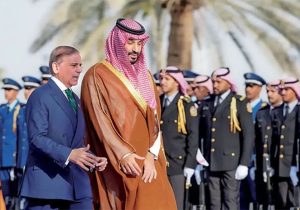
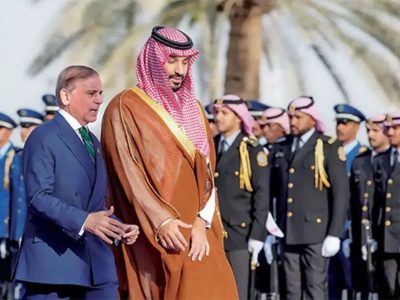
Pakistani Prime Minister Shahbaz Sharif met in Riyadh on Wednesday, September 9, with Saudi Arabia’s crown prince and ruler. The two sides signed a very important defense agreement that would significantly increase the level of military and security cooperation.
While there is no direct reference to the nuclear bomb in the agreement, the agreement emphasizes that “any violation of each of the two countries will be considered a violation of both countries.”
“The purpose of the agreement is to develop defense cooperation aspects of the two countries and to strengthen the common deterrence against any aggression,” the statement said.
Pakistan and Saudi Arabia also emphasized their joint adherence to the security of the two countries as well as the necessity of “peace in the region and the world”. According to the statement, the agreement was “aimed at developing the dimensions of defense cooperation between the two countries and strengthening joint deterrence against any aggression.”
Indian and IMEC issue
For India, this defense treaty sounds several strategic alarm. “The agreement is one of the hottest periods in Saudi -India,” the Italian Institute of International Political Studies wrote in an analysis. Delhi is concerned that hugging Riyadh to Islamabad will be able to undermine his position as Saudi Arabia’s Asian partner.
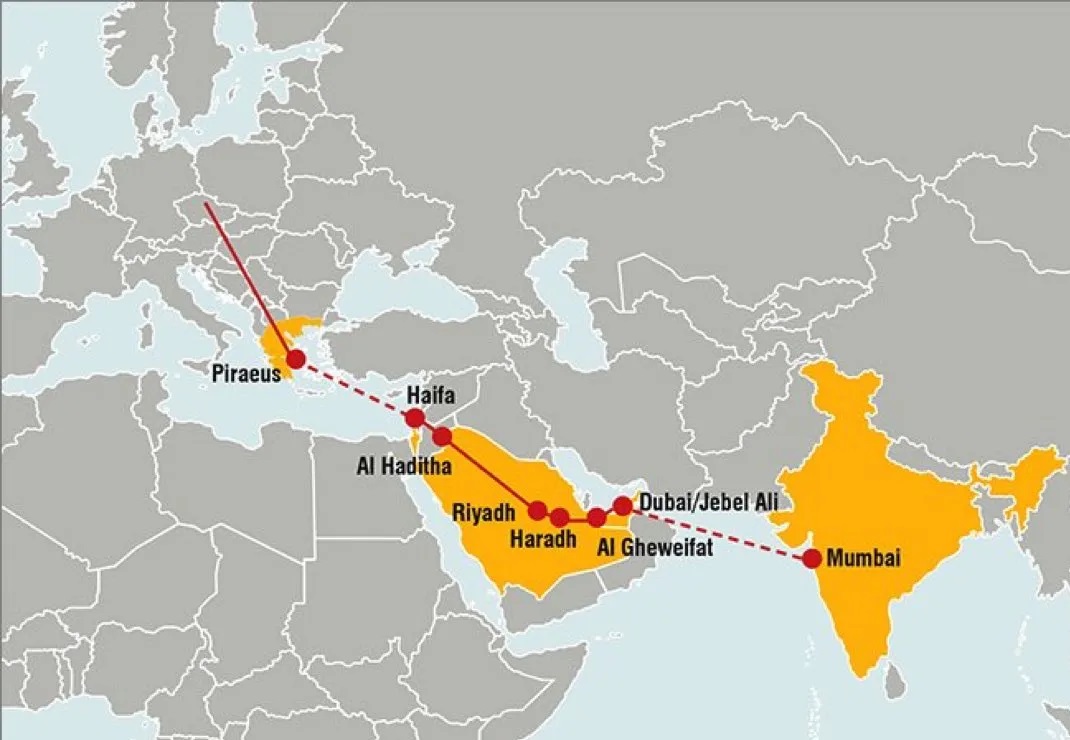
Map of Indian-Middle East Economic Corridor (IMEC)
More specifically, the development of the Indian-Corps-Roppa Economic Corridor (IMEC), in which Saudi Arabia, along with the United Arab Emirates, must become a pivotal hub for India to Europe, may lose its acceleration if Saudi Arabia’s strategic calculations are changed. “Even if trade cooperation continues, it will be more difficult to maintain political confidence, and this shadows the fate of the corridor, which was named as the balance of equilibrium against China’s Belt and Road Initiative.”
Indian security agencies are also worried that the treaty may make Pakistan more in their competition with India. Although Saudi officials insist that this agreement is not against Delhi, Riyadh’s official commitment to Islamabad cannot be ignored.
Regional works
The Chinese have a particular view of this agreement. Lee Shejun, a researcher at the China and Arab Research Center on Reform and Development, in an interview with Shinhwa, warned of exaggerated interpretations of the agreement. He emphasized that the agreement was neither an instantaneous decision nor a targeted reaction to a particular event.
Lee told Shinhwa that Saudi Arabia has shown strong interest in developing relations with Pakistan in recent years, taking into account ideological, geographical, energy and security factors. He added that in addition to mutual support in the main interests, Saudi Arabia has pledged significant loans and expanded its investment in Pakistan, which is the importance of these actions.
“Therefore, the conclusion of the mutual defense pact between the two countries is ultimately a natural outcome of Saudi Arabia’s security and defense policy and deepening Riyadh and Islamabad relations in the security field,” Lee added. “This move, led by Saudi Arabia, will help promote discussion of the concept of mass defense among the GCC countries,” he said.
(Tagstotranslate) Pakistan (T) Saudi Arabia
منبع